
Every Picture Tells A Story
We got some great letters, EMails and reminiscences about Printshop posters; there’s good material in the Arts Workshop book [see end for links]; some things we remember ourselves; some of it needed a bit of prompting from a web search.
If you’ve got something to add about posters we already have – or a photo/scan of one we haven’t seen – we are making this an archive that will remain online, let us know and we’ll add it!
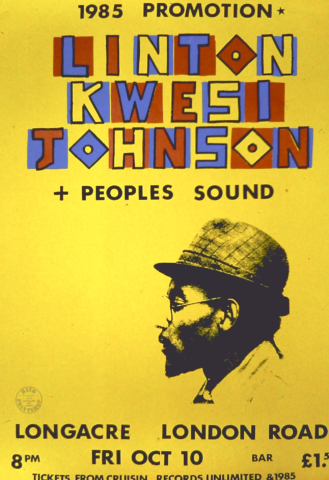
Linton Kwesi Johnson – 1985 Bookshop gig
Design: Dominic Fox
One of the bookshops best sellers was a book of poetry, Dread Beat an Blood, by the pioneering Reggae poet Linton Kwesi Johnson. Published in 1975 and followed by a musical album. This was poetry with a driving reggae beat tackling themes, such as “wrongful arrest, the “sus” (section 4 of the Vagrancy Act 1824, which allowed police to stop, search, and arrest individuals deemed “suspected persons” loitering with intent to commit a crime. Used heavily against Black communities in the 1970s), urban violence and the need to engage in hard political activity (Guardian). The poster represents a gig that never took place. LKJ couldn’t make the date, so we rescheduled and because demand for tickets outstripped the capacity of the Longacre Hall we presented at a later date in a nightclub next door to the Theatre Royal.*
Design was inspired by vintage boxing match posters from the 1960s and 70s, featuring bouts with Muhammad Ali and George Foreman, with yellow background, black and red lettering and photo cut outs of the fighters.
* The subsequent replacement gig would have been at ‘Tiffany’s’, later ‘Chemies’ and now demolished [7 Dials, Sainsbury’s Local, Thai Balcony, etc.]
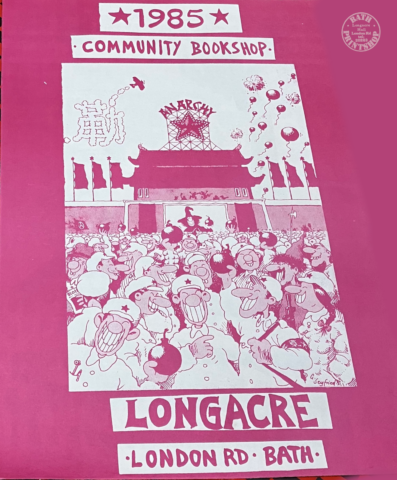
1985 Bookshop Gigs
Dominic Fox
Apart from sales and an initial grant from the Arts Council we needed to organise benefit gigs like most local organisations to keep going. Reading your website made me a bit sad that nothing much has changed in financial terms all these years later. I am Chair of a SE16 organisation, Surrey Docks Farm (surreydocksfarm.org.uk/) which celebrated its 50th anniversary recently!
Eileen O’Haire
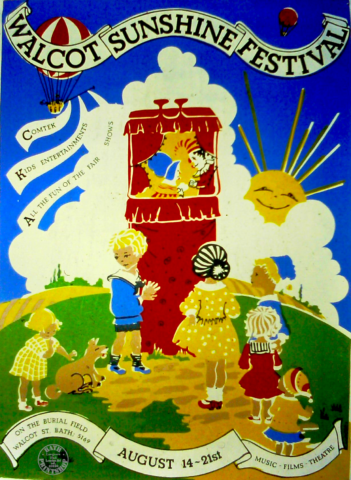
Walcot Sunshine Festival 1976
Rocky plays to a huge crowd at 1976 Sunshine Festival [from the Arts Workshop book, see below]
Corinne D’Cruz writes: On the last evening there was a rock concert on the stage at the bottom of the field. Top of the bill was our own Rocky Ricketts and the Jet Pilots of Jive, featuring (of course) the fabulous Rockettes. Phil Shepherd was the hippy promoter with his mane of red hair who appeared naked onstage to introduce the band to a huge crowd. At the end of the show Vince Pube, Rocky’s seedy manager, took to the microphone and announced: “Well, that’s the end of the festival. We won’t be organising it next year so you can do it your fucking selves’’.
Ralph Oswick (Vince himself) describes the fall-out: The comments were directed at the audience, but it was a powerful sound system so people as far away as Camden Road heard it and complained. The council was not amused and wrote to inform me that even though they presumed it was a joke, I could be ‘prosecuted for obscenity’. The festival did go ahead the following year but the organisers were required to submit an event plan in advance. The plan ended with a proposal for a concert involving ‘one loud awful pop group, swearing and drugs from 3pm-9pm’.
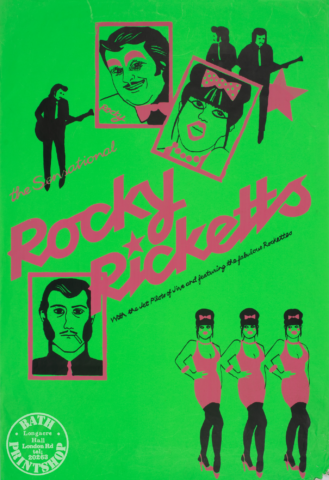
Rocky Ricketts and the Jet Pilots of Jive
Rocky Ricketts was born out of show, Spotty Blelb, and was created originally as a character in the show but then went on to front a band and eventually to take on a life and story of its own, with quite a large following of its own and went on to spawn various other bands and even make an LP for Crescent Records. This was a Live recording titled “Live At The Pav”.
It was great fun and satisfied all our desires to be rock stars!
Brian (Rocky Ricketts) Popay
We had a gig at a dockside bar in Rotterdam named The Flaming Star club. Ralph as usual insisted that we wore clean, ironed shirts and white makeup. This evidently rubbed some of the tough thugs in the audience up the wrong way, and as timid arty types we were feeling distinctly nervous. Unti the landlord, twice the size of any thug, came onstage with a crate of Dutch beer, saying “Hey, Rocky and the Jets – what a great band – let’s give them a big hand!” Once we had the support of the gigantic landlord, everyone cheered and danced till closing time. I remember thinking “This bar must be very like the Star Club in Hamburg”
Mike Godwin aka. Brian Damage, guitar
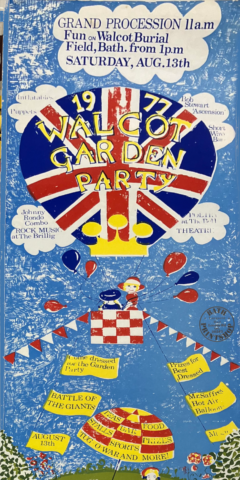
Walcot Garden Party 1977
Design: Reflects house style of Bath Arts Workshop.
A low budget one-day version of previous bigger festivals,expressing the creative spirit of Bath’s ‘Artisan Quarter’ heralded by a splendid mural showing their majesties as Hollywood film stars. The poster seemingly proclaims innocent fete-like events in store, but, as with all BAW/Walcot happenings, there would be an ‘edge’ of naughtiness. Downsizing reasons: Extreme financial pressures and Bath City Council’s remarkable lack of humour at the co-ordinators’ tongue in cheek mention of swearing and free drugs, a reference to an expletive delivered from the stage in 1976, apparently seen as an attack on the city’s moral fabric!
Ralph Oswick
Bath Arts Workshop & Natural Theatre Co.
Artists mentioned on the poster:
Short Wave Band
Stuart Gordon & Phil Harrison [said by one source to be George’s cousin], who played original material & unusual renditions of well-known folk material. There were bigger lineups on the 3 albums they made. Stuart went on to work with prog-god Peter Hamill in the former Crescent Studios adjacent to the Walcot Festival field, lots of other session work and raised many a Bath roof with The Three Caballeros.
Bob Stewart
Folk Musician and author, Bath resident at the time, best known for playing a variety of the psaltery called a harpeleik. There are several albums in the archives, including with Finbar Furey and Van Morrison, and music for some major movies. Nowadays he lives in California, and as RJ Stewart is a successful and revered author on matters mystical, magical, Celtic, and indeed musical, last reported still playing at conventions.
Johnny Rondo Trio
Assembled by Dave Holland, who is another of those figures whose subsequent career is just too long and complicated to fit in here, but the Trio – grown out of various Arts Workshop projects including Rocky Ricketts, probably included unique Jazz/Performance maverick Lol Coxhill
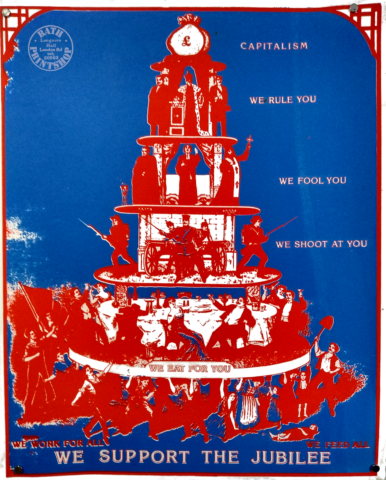
We Support The Jubilee
This is one of historically many versions of a design that can be traced back to a Russian flyer in c.1901 and the Belgian Labour Party in 1900; its American version [1911] is known as ‘The Pyramid of Capitalist System’. See wikipedia.
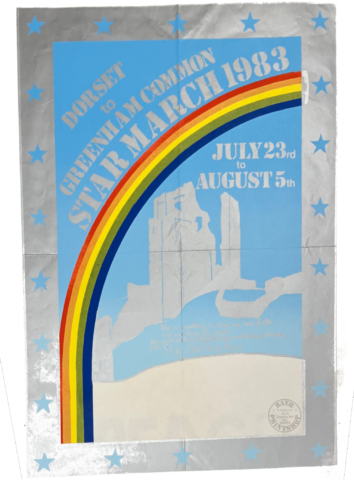
Greenham Common Star Marches 1983
Design: probably national
Ah, Greenham! We went out and met the first women as they came into Bath and accompanied them to the churchyard at the top of Walcot Street and made welcoming speeches and listened to them and gave them a send-off. We also went to be big demos there, like encircling the base and some of us got arrested. We also used to go and do nightwatch there to protect them from attacks by hostile neighbours.
Later one of my daughters abandoned her A levels and went to live there, staying for a couple of years and getting arrested endlessly.
Diana Francis – Bath Stop War
The Star Marches converged on Greenham from all directions and built towards a big demo event. All of it was an effective publicity campaign to keep the issue talked-about – and of course eventually the missiles left again.
Bath was also on the route of the very first women’s march that established the Peace Camp at Greenham.
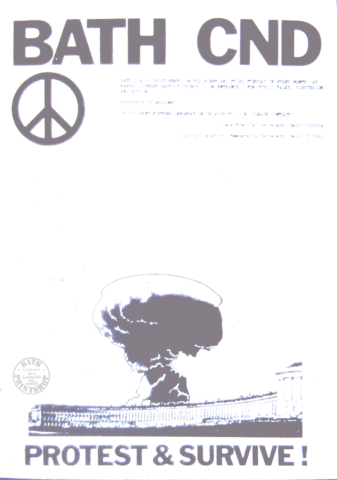
Bath CND
Clearly a locally designed poster
The slogan is a pun on ‘Protect and Survive’ which was a really rather pathetic government leaflet about how you could possibly survive a nuclear attack if it was a long way away [Bath was a target because of its Naval Procurement and Arms Manufacturer offices]. It’s hard to think the measures would have been very effective.
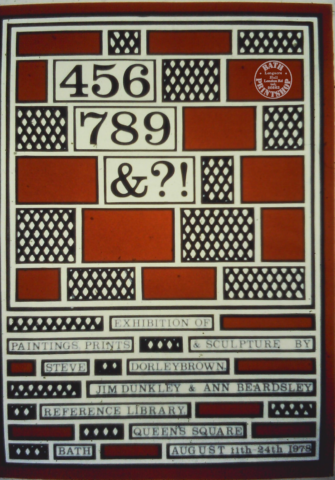
456 789 &?!
Design: Steve Dorley-Brown
Steve Philbey (1943-2022) was a painter, muralist, graphic artist, subvertiser, photographer and chronicler of The Saint-Just Mob. And also variously a factory worker, Father Christmas, painter and decorator, film extra, demolition worker and Victoria Line tunneller. He has work in the collections of The Museum of Contemporary Art Utrecht, Artists Union Moscow, Russell Coates Museum Bournemouth, The Photographers Gallery London, The Williamson Art Gallery and Museum Birkenhead, and The Victoria and Albert Museum London.
Annie Beardsley is still involved with visual, performing and community arts and activism in Bath and around.
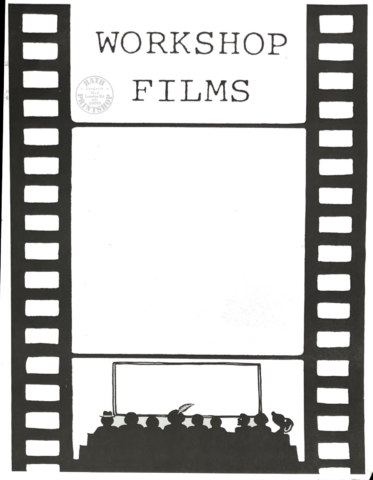
Workshop Films
Key figures include Phil Shepherd, whose help on this exhibition has been enormous, and Paul ‘Nasher’ Nashman. The Fringe is showing a long-unseen Nasher feature ‘The Edge’ (shot at Severn Beach) on June 1st.
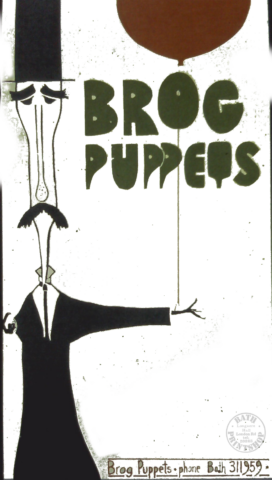
Brog Puppets
“At nearly 89, I do remember designing and printing this poster fifty years ago. It represents the undertaker from ‘St George and the Dragon’ the show I performed in Bath Arts Workshop HQ in Walcot Street during the Fringe Festival, then known as ‘The Other Festival’, in 1974.
I had just, at 40, given up my company car and salary, in order to go professional as a peripatetic one man puppeteer. In this I was greatly encouraged by Ralph and the others at Bath Arts Workshop and The Natural Theatre Co.. I was there as a substitute for Ted Milton, of Mr Pugh’s Puppet Theatre (and later of his band, Blurt).
In July ’77 the Naturals took me and my theatre to Hamburg for a festival. There I learned that their wonderful style wasn’t as easy as it looked!
In that year, I had a week’s booking in Tower Hamlets, thanks to Phil Shepherd, who also put me up. It was the beginning of a very happy 25 years. Brog Puppets performed twice at The National Theatre (alright, in the foyer), The RSC Stratford, the Bristol Old Vic, and numerous other theatres, Arts Centres and Festivals, at one of which I met Juliet (then a mature Drama undergrad at Bristol Uni), who after the three Broglets began school started performing her own solo shows as Mrs Brog, in schools and Centres such as Battersea Arts. We thus made a living for the next quarter century. I did ‘Brog’s Last Show’ in Bristol in 2002.
Dennis Harkness
Brog Puppets
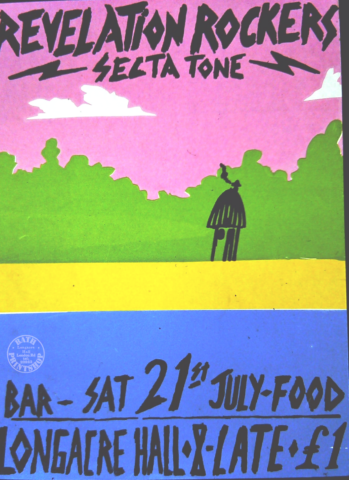
Revelation Rockers & Sectatone
Design: Dominic Fox?
We met Sectatone by accident. We were promoting a gig in the Longacre Hall with three local bands and the PA failed to materialise. We discovered a set of large speaker boxes stacked up in the kitchen and finally tracked them down to the Rainbow Steel Band just off stage from the bandstand in Victoria Park. Could we hire their speakers? We could not, but they would be very happy to come down and play some reggae music. One of the bands rustled up a PA and Sectatone team ran in and started manipulating the speakers into mountainous shapes in each corner connecting the now active speakers with the single record deck sat on a large block of foam to absorb unwanted vibrations coming from the hall’s wooden floor. Before we knew it, disaster turned into a sonic tour de force, one of many.
For more about Dominic see above.
The Rainbow Steel Band is a great Bath story – another case when our city that is often caricatured as a toff-ish tourist town has been a pioneer and a cultural leader. Sectatone came out of the same set of people – Barbadian rather than Jamaican – and were themselves as active as, and ranged around the country as much as, the name systems from the bigger city down the road in Bristol. For more insight there is a 2 hour + interview video on YouTube.
Revelation Rockers shortly became Talisman, one of the Westcountry’s highest profile reggae bands, still intermittently in action with some original members. History page here.
SPARK MAGAZINE
The Printshop also helped produce Bath’s own Community Newspaper, Bath Spark [1978-82]. The first four issues were even screenprinted onto big pieces of paper, then folded down to a manageable size [the more expensive offset litho came pretty quickly]. It’s too big a topic to shoehorn entirely into this exhibition, maybe deserves one of its own, anyway there’s a great article about it online here by Steve Poole, one of the key workers, now a Professor of Radical History at UWE.
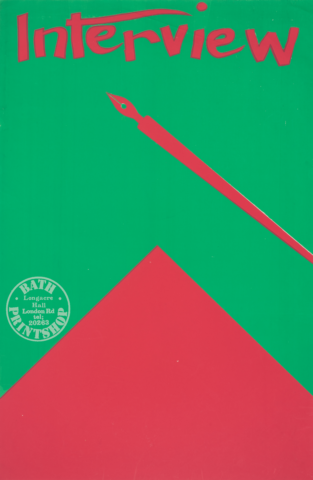
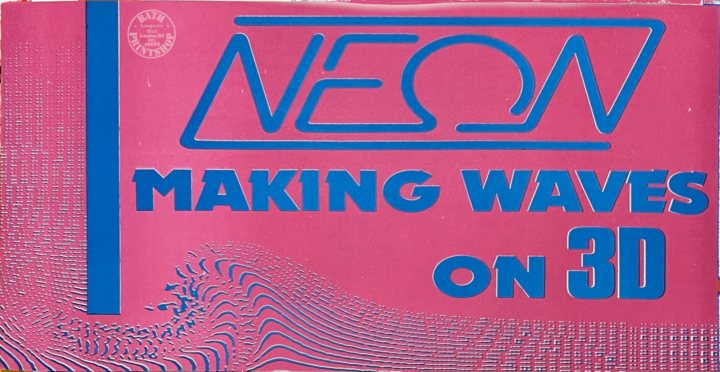
Interview
Every city has them, the bands that should have made it, and Interview were one of Bath’s many, can we call it the electro-pop period? They made 2 albums for Virgin in 1979-80, their singles got some airplay but insufficient. Founder member Pete Allerhand may be better remembered in the city now for the sequence of bands that came down to The 3 Caballeros; subsequent drummer Manny Elias was simultaneously a member of Neon (who begat the fairly famous Naked Eyes, but without him), and was then quickly absorbed into the Tears For Fears contingent, who did very much better than any so far mentioned.
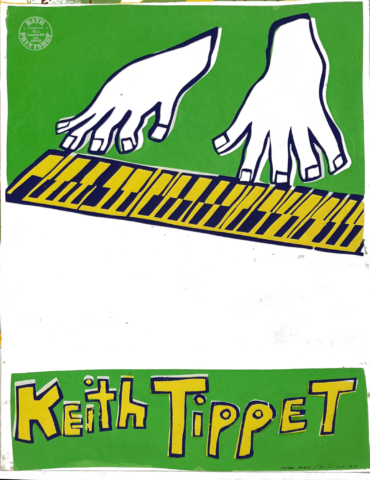
Keith Tippett
At his peak one of the most highly rated British pianists and composers at the outer limits of jazz. A native Bristolian who retained his accent, he returned his base west from London in the Printshop’s lifetime, and added occasional local projects to his national and international work. Definitive biography just published, ‘Mujician’ by Martin Phillips.
This, like several others of the posters on this page, was a blank on which could be scrawled details of the actual gig.
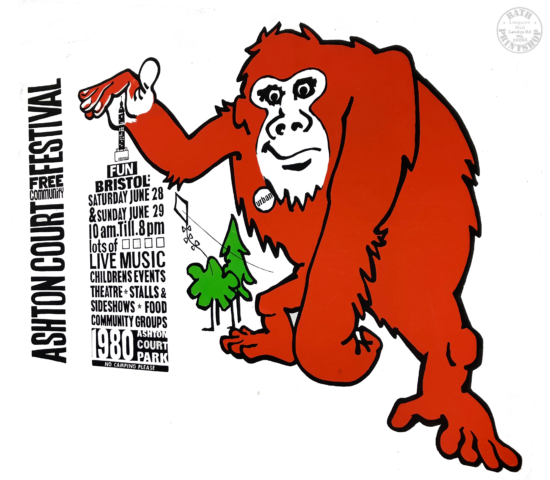
So the big city up the road didn’t have a print facility like Bath did…
Ashton Court, the community free festival on the council-owned estate just over the Clifton Suspension Bridge was a great day or weekend out. Perhaps the King Kong figure is appropriate because it too ran a little out of control this year. Kept alive by the community and the local music business, clobbered by commercial interests: lost and much missed…
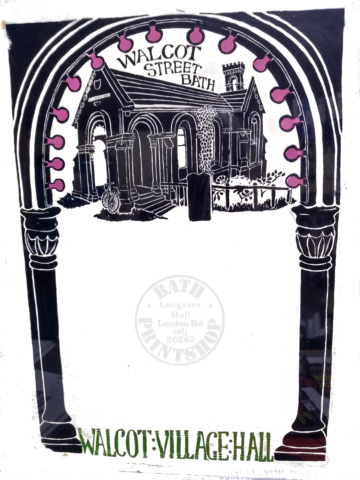
Walcot Village Hall
Design: Martha Allen
Nowadays more often known as Walcot Chapel – also the name of the Methodist Church up the road – the former Walcot Mortuary Chapel was a key performance venue for the Arts Workshop and long afterwards. Currently closed for refurbishment but otherwise still used by Fringe Arts Bath and many others for exhibitions.
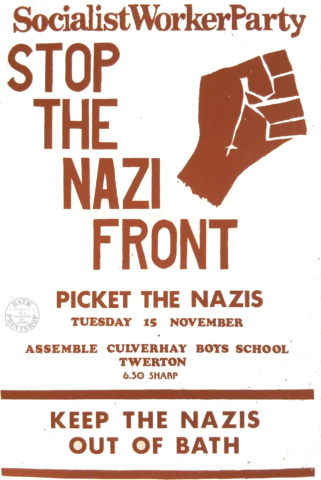
Seems like the same problems keep repeating themselves, though the names have changed. The SWP still exists but seems a shadow of its 1970s-80s self.
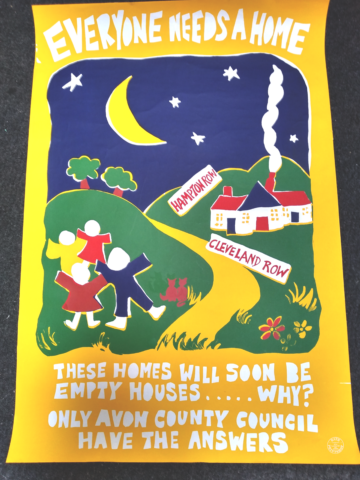
Everyone Needs a Home
Hampton Row & Cleveland Row make up a long terrace of workers’ houses from the 2nd decade of the 19th Century, familiar to anyone who walks the canal towpath. Those who know about ‘The Sack of Bath’ and the history of development in our fair city will know it took a very long time for official opinion to acknowledge that ‘artisan dwellings’ were also an attractive part of the heritage townscape, and this terrace (amongst others) was for decades under the shadow (‘planning blight’) of a variety of traffic-centred plans, two of which were The Buchanan Tunnel and The Beckford Spur (part of the extended version of the “Batheaston Bypass”).
We’re uncertain as to the exact campaign connected to this poster, but there were many plans to clear the Row of residents, who at that point would have been mostly ‘short-life’ housing, though some were previously squatted. The Row is still happily inhabited, part owner-occupied, part social housing & Bath Housing CoOperative; even the derelict houses at the end, too close to Brunel’s London-to-Bristol main line, have been renovated.
Much more about Bath Arts Workshop and the other goings-on of the period can be found in the excellent and compendious book ‘Bath Arts Workshop – Counterculture in the 1970s’, available from Tangent Books or via www.bathartsworkshop.org
Bath Fringe is indebted for this exhibition to Phil Shepherd,
Louise & Jesse Ingham, Su Fahy, Tim Vyner, all contributors,
– and everyone who did the original events!