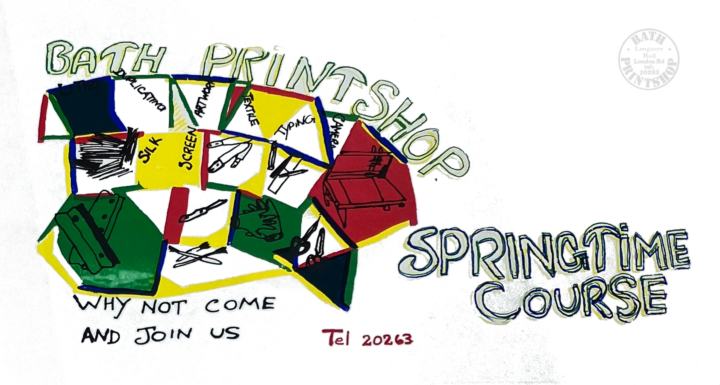
Printshop Worker tells all
WHAT ABOUT THE WORKERS, EH?
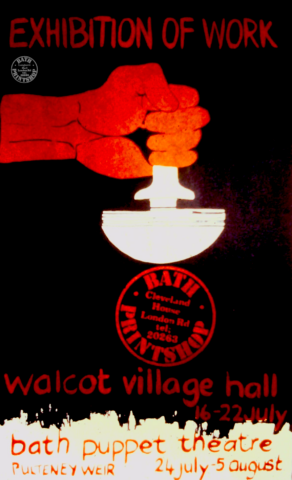
Bath Printshop Premises
January 1977 – December 1978 Basement, Cleveland House, London Road, Bath
January 1979 – 1983 Longacre Hall, London Road, Bath
Bath Printshop Staff
Nigel Leach, 1977 – 1981, Full-time
Louise Ingham, 1977 – 1981, Initially full-time, then part-time
Janette Kerr, 1978 – ?, Full-time
Peter Stone, 1978 – 1983 Initially a p/t trainee, Avon Community Placement Unit and subsequently full-time
Clive Young, 1978/9?, YOP placement
Jaki Chamberlain, 1978/9?, YOP placement
Maggie Chudley, April – September 1980?
Patsy Preston, 1979 – 1981, part-time 3 days a week
Jackie Ricketts, 1978/9?, YOP placement
Meg Roberton, 1979 – 1982? Accounts
Cal Francis, 1979 – 1981? Administration & accounts
Maggie Kelly, 198, – 1983? Initially a volunteer, then p/t, then f/t
Sue Watkinson, 1981, – 1982, Full-time
Mike Hill, 1981/2, YOP placement for 6 months
Jayne Stacey, 1981/2, YOP placement for 1 year
Andy ? September, 1982 – ?, full-time
Jane Coe, 1982/3, YOP placement
Sharron Lea, September 1982 – ?, full-time
Reflections on Community Arts at Bath Printshop 1980-1983
Maggie Kellie
I worked as a community arts worker at Bath Printshop from 1980 – 1983, first as a volunteer then joining the staff team full time 1981. I taught silkscreen printing and graphic design and contributed to the collective management. I got involved in the project through being a user of the Longacre Building which, alongside Bath Printshop, housed a variety of community groups and projects at that time.
Reflecting on my time at Bath Printshop as a community arts worker, it was not just the role of art in community arts, but equally the community aspect of the work which was important to me and made it such a great place to work.
My memory of the Printshop is one of a vibrant place which served an incredibly diverse range of individuals and groups! We printed everything from Greenham Common posters to local parish newsletters. We produced some stunning poster art, published independent newspapers including Bath Spark, but also offered people the means to run off basic newsletters on an old Gestetner machine. There was something for everyone. And, if you were willing to come in and learn how to do it yourself, it was all done for the cost of the materials.
Bath Printshop was part of a particular historical moment when a number of independent print and publishing ventures sprang up. These challenged the often costly and elitist art and publishing worlds, enabling all sorts of people to learn how to design and publish work independently. The contrast with where we are now is stark, both in terms of opportunities for individuals and groups to produce and publish their own work and spaces which foster vibrant communities.
In terms of publishing, in the early days of the internet there was a great enthusiasm for it as way to democratise that sector. Anyone could start a blog, so the story goes, without publishers gatekeeping who and what got published. And it was all relatively cheap – just the cost of an internet connection. Of course, while there is now increased access to views which challenge mainstream orthodoxy (at least in some countries), this is in the context of the overwhelming avalanche of social media misinformation and AI slop pouring out of our screens for commercial and political ends.
One of the most damaging aspects of online life is the invisible hand of the algorithms. Designed to keep us online, they create self-affirming echo chambers insulating us from the views of others and prioritising content which aims to provoke outrage, anger and the feeling of being in the correct moral camp.
In contrast, at Bath Printshop, you could find community group volunteers, people from faith communities, people from various ethnic backgrounds and members of radical protest groups all working in the same physical space, sometimes alongside each other. In a situation like that it’s hard to believe those who want to tell you that ‘others’ are woke warriors threatening your freedom of speech or immigrants threatening your way of life. Physical presence fosters mutual tolerance and understanding, creating community solidarity at a basic level.
The contrast with where we are now in terms of the art in community arts is also stark. The intervening years has seen the development of many online tools aimed at providing creatives with shortcuts to the work of producing art. Some of these are helpful (I don’t want to go back to cutting up lines of text with a scalpel and glueing them down onto sheets of paper marked up in blue pencil!) but others are not. When software becomes a means of avoiding the sometimes messy and time consuming work of developing creative ideas, the resulting work can be deceptively impressive but essentially hollow. “Creativity” is outsourced to external technology and as a result human creativity atrophies.
The hidden side of this outsourcing also threatens the autonomy and livelihoods of many creative practitioners. At Bath Printshop access to the means of producing work was in the hands of the local community. Now anyone using online means to disseminate or produce creative work risks having that work stolen, as tech bros scrape and ape of the work of artists, repackaging it for profit.
Reflecting on my time at Bath Printshop in the current social, political and technological context has been thought provoking. It made me ask “How is it relevant to us now?” Clearly, we need to challenge the tech bros hugely damaging political and economic power over our lives. Control of technology which has such far reaching impacts should not be left to a small group of billionaires bent on personal profit. Instead, decisions about which technologies are prioritised and how they are developed, need to be made within an ethical framework which critically evaluates how they will contribute to social and environmental justice.
Within the arts we need to prioritise physical community arts spaces (and indeed free public spaces of all kinds) where people can access facilities to produce work independently. We need face to face engagement where we can learn, play, rub shoulders and dialogue together. We need spaces which foster the teaching and learning of critical artistic skills; places which encourage people to develop their creative potential through an embodied practice which goes beyond screen based engagement.
Sharron Lea,
Printshop worker
I feel it was a very community engaged period, with a lot of diverse things going on and that the Printshop, the Bookshop and the Music events all brought people together, activists and rebels, feminists and rastas, in ways that seem rarely seen these days. The issues are the same, some getting more critical, some, like climate change, newer and more prominent.’